


World’s First Native Power System Large Model Unveiled Equipping the Next Generation Power System with an “Intelligent Brain”
Release Time:2025-12-22
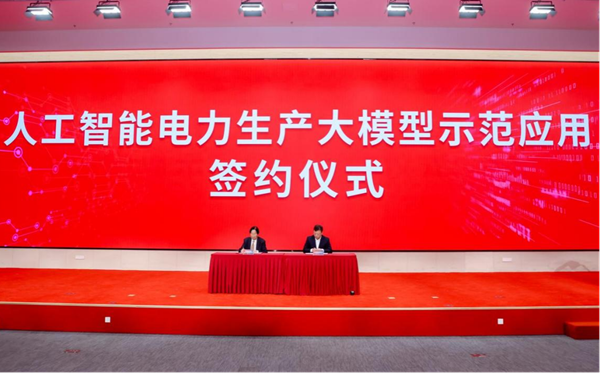
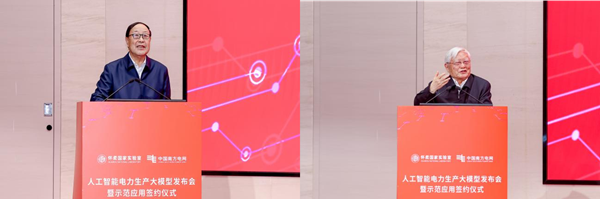
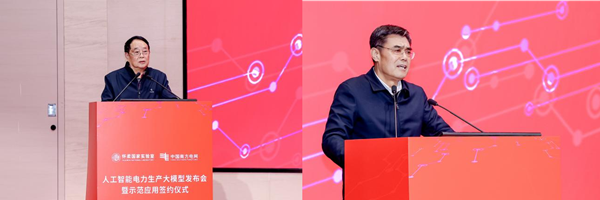
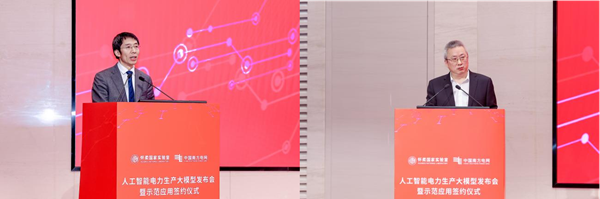
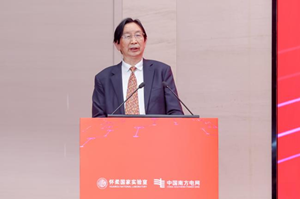
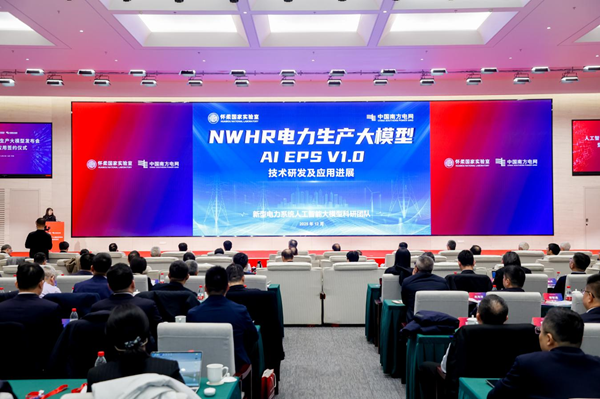
On December 19, a launch event for the AI-Powered Power Production Large Model, along with a signing ceremony for demonstration applications, was held in Beijing. The event was jointly co-hosted by Huairou Laboratory and China Southern Power Grid (CSG).
In attendance were Zhuang Shuxin, Secretary-General of the State-owned Assets Supervision and Administration Commission of the State Council (SASAC); Wang Song, Deputy Director-General of the Sixth Department of the Ministry of Science and Technology (MOST); Xu Jilin, Deputy Director-General of the Department of Science and Technology at the National Energy Administration (NEA); Meng Zhenping, Chairman of China Southern Power Grid; Tang Guangfu, Director of Huairou Laboratory and Academician of the Chinese Academy of Engineering; as well as distinguished academicians and experts including Zhou Xiaoxin, Yang Qixun, Li Licheng, Zhou Shouwei, Yue Guangxi, Guo Jianbo, Liu Jizhen, Sun Jinsheng, Shu Yinbiao, Wang Qiuliang, Wang Chengshan, Zeng Rong, Bi Tianshu, Bie Zhaohong, Li Jian, Xu Helian, and Shi Boming.
Representatives from Pujiang Laboratory, Tsinghua University, Xi’an Jiaotong University, Hunan University, North China Electric Power University, Chongqing University, Dongfang Electronics Corporation, and Beijing Zhipu AI, along with officials from the Beijing Municipal Science and Technology Commission, Administrative Commission of Zhongguancun Science Park, and the Huairou District Government, also attended the event.
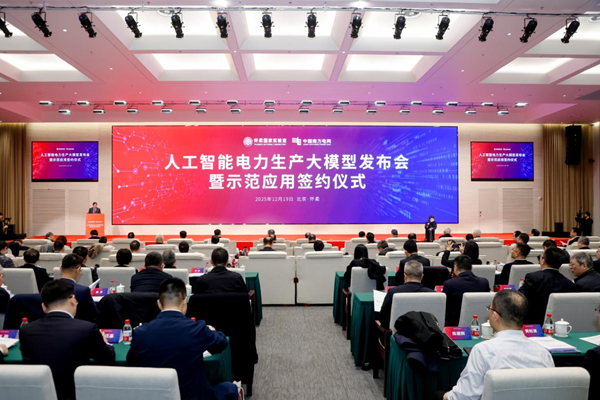
At the event, the NWHR Power Production Large Model (AI EPS V1.0), an innovative native power-domain large model with a groundbreaking underlying architecture,was officially launched. Serving as a key intelligent core enabling the “transparent operation” of the next generation power system, it is the world’s first native power large model innovated from the ground up. Designed specifically for power systems, this specialized model marks a significant breakthrough in AI applications within the vertical field of power production.
In response to the major strategic challenges and urgent needs of building a next generation power system, there is an urgent need to create a “smart brain” for the power grid that can sense in real-time, analyze accurately, make intelligent decisions and operate adaptively.
In 2023, Huairou Laboratory joined forces with China Southern Power Grid to focus on the country’s major strategic needs. They established the country’s first joint R&D institute co-founded by a central state-owned enterprise and a national laboratory, and formed a dedicated R&D team for power-domain large model development.
Led by Professor Li Licheng—Academician of the Chinese Academy of Engineering, head of the research team at Huairou Laboratory, and Honorary Chair of the Expert Committee of China Southern Power Grid (CSG)—the team leveraged the institutional advantages of the national laboratory and CSG’s vast data resources and rich operational scenarios. It brought together researchers from universities, enterprises, and national research institutes to conduct a concentrated “grand scientific campaign” at Huairou Laboratory. This effort fostered deep interdisciplinary integration and established a tightly coupled innovation ecosystem spanning “Power + AI” across academia, industry, research, and application—achieving end-to-end integration from theoretical research and technological development to systematic deployment.
Centered on the core requirements of China’s power system and grounded in the unique operational dynamics and real-time variability of the grid, the R&D team originally developed the architecture of AI EPS V1.0. For the first time, it achieved deep integration and coordination across three dimensions: measurement data, physical laws, and operational regulations—resulting in breakthroughs in three core capabilities:
Real-time performance: The model enables real-time perception of fine-grained grid operating states. By designing a spatiotemporal graph state-space model, the team can rapidly predict grid states in just tens of milliseconds.
Precision: Physical laws of power systems are translated into AI-interpretable and executable function sets and deeply embedded into the model architecture, enabling the model to effectively understand and apply physical constraints. As a result, all computations, analyses, and decisions inherently satisfy grid safety and operational requirements, leading to significantly improved numerical accuracy. The model maintains consistent precision levels across billions of unseen operating conditions even under few-shot training scenarios.
Intelligence: The team designed a heterogeneous space semantic alignment unit, The team designed a heterogeneous spatial semantic alignment unit to accurately interpret power system technical standards. This innovation substantially improved grid risk assessment accuracy, providing robust technical support for secure, efficient, and autonomous grid operations under high-penetration renewable energy integration scenarios.
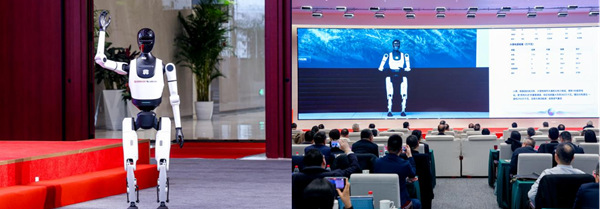
The newly launched NWHR Power Production Large Model has already been successfully piloted at the Dali Power Supply Bureau of China Southern Power Grid in Yunnan Province, fully demonstrating its capability for real-time operation, high numerical calculation, and intelligent decision-making — as well as its notable self-adaptiveness under new environment:
Rapid adaptation to massive new operating conditions: Under extreme scenarios with high renewable penetration and frequent structural changes, the model improves the accuracy of power flow calculation by two orders of magnitude.
Autonomous discovery of optimal operating points: The model identifies high-consumption operating points within milliseconds, increasing average renewable energy consumption by an average of approximately 25%.
Generation of new operational strategies: system-level optimized operation plans within minutes - transforming traditionally complex procedures that require multiple sequential operations into a single global optimization process.
Fast adaptation to new systems: When new equipment is commissioned, only minimal sample-based fine-tuning is required to maintain a stable level of prediction accuracy.
Since the pilot began, the system has reduced the time required to generate dispatching plans from hours to minutes. By increasing renewable energy integration, it is expected to deliver over 120 million kilowatt-hours of additional green electricity annually to the Dali power grid, reducing carbon dioxide emissions by approximately 60,000 metric tons per year. Operational results indicates that the deployment of the AI EPS V1.0 will provide an intelligent solution for renewable integration and will also lay a critical technical foundation for the future “plug-and-play” and unrestricted, grid-friendly integration of large-scale, distributed renewable energy resources.